> ## Documentation Index
> Fetch the complete documentation index at: https://docs.phylax.systems/llms.txt
> Use this file to discover all available pages before exploring further.
# OP Stack
> OP Stack specific implementation of the Credible Layer
The OP Stack implementation uses [Rollup-Boost](https://github.com/flashbots/rollup-boost) to connect an external sidecar assertion validation components with the L2 sequencer through a bridge proxy.
For the general integration path, see [Network Integration Overview](/credible/network-integration).
Looking for the Besu/Linea pattern? See [Linea / Besu Integration](/credible/network-integrations/architecture-linea).
## Architecture Diagram
```mermaid theme={null}
---
title: OP Stack Implementation Architecture
---
flowchart TD
classDef sequencer fill:#0288d1,stroke:#01579b,stroke-width:2px,color:#fff
classDef credible fill:#7b1fa2,stroke:#4a148c,stroke-width:2px,color:#fff
classDef rollupBoost fill:#388e3c,stroke:#1b5e20,stroke-width:2px,color:#fff
subgraph Sequencer[**Sequencer**]
SequencerCL[op-node]
SequencerEL[op-geth/op-reth]
end
subgraph CredibleLayer[**Credible Layer**]
AssertionEnforcerEL[op-reth]
AssertionEnforcerCLI[CLI]
AssertionEnforcerDapp[Platform]
AssertionDA[Assertion DA]
subgraph AssertionEnforcerBlockBuilder[Block Builder]
AssertionEnforcer
end
end
subgraph RollupBoost[**Rollup-Boost**]
RollupBoostProxy[Proxy]
end
SequencerEL --> |Fallback Blocks + Validation| RollupBoost
AssertionDA --> |Serve Assertions| AssertionEnforcerBlockBuilder
AssertionEnforcerCLI --> |Auth + Apply| AssertionEnforcerDapp
AssertionEnforcerDapp --> |Store bytecode| AssertionDA
AssertionEnforcerDapp --> |Fetch assertions| AssertionDA
AssertionEnforcerEL <--> |Pulls State + Txs| SequencerEL
AssertionEnforcerEL <--> |Provide Best Transactions| AssertionEnforcerBlockBuilder
RollupBoost <--> |Request Credible Blocks| AssertionEnforcerBlockBuilder
RollupBoost <--> |Request Credible Blocks| SequencerCL
class SequencerCL,SequencerEL sequencer
class AssertionEnforcerBlockBuilder,AssertionEnforcerEL,AssertionEnforcerCLI,AssertionEnforcerDapp,AssertionDA credible
class RollupBoostProxy,AssertionEnforcer rollupBoost
```
## System Components
### Sequencer
* **op-node**: The main orchestrator node in the OP Stack, responsible for sequencing transactions and maintaining consensus with the execution layer.
* **op-geth/op-reth**: The execution layer clients (Geth or Reth) that process and execute transactions, providing the EVM environment for the rollup.
### Credible Layer (Sidecar)
* **[Block Builder](/credible/glossary#block-builder)**: The component of the network that simulates transactions and runs assertions before transaction finalization to ensure they don't violate defined conditions.
* **op-reth**: The execution layer client within the Credible Layer that processes transactions and maintains state.
* **[`pcl` CLI](/credible/glossary#pcl-cli)**: Command-line interface for developers to write, test, and deploy assertions to the system.
* **[Platform](https://app.phylax.systems)**: The web application interface to deploy, manage, and view assertions and projects.
* **[Assertion DA](/credible/glossary#assertion-da-data-availability)**: The Assertion Data Availability layer, which stores assertion bytecode and serves it to both end-users and the Assertion Enforcer for execution.
### Rollup-Boost
* **Proxy**: Acts as a bridge between the block builder and the sequencer, enabling integration without requiring changes to the sequencer code. It handles new block requests and fallback validation.
## Component Interactions
* The Credible Layer op-reth pulls state and transactions from the Sequencer op-geth/op-reth.
* The Credible Layer op-reth provides best transactions to the Block Builder.
* The Block Builder enforces assertions and produces credible blocks, which are requested by Rollup-Boost.
* Rollup-Boost requests credible blocks from both the Block Builder and the Sequencer op-node.
* The Assertion DA serves assertion bytecode to the Block Builder, ensuring up-to-date enforcement.
* `pcl` and the platform provide interfaces for assertion development, submission and management.
## L1-Originated Transactions
OP Stack networks can define an L1-originated transaction validation policy alongside the ordinary sequencer-selected transaction path.
An integration should specify where assertion validation runs, how validation results are reported to sequencing components, and what metadata is sent to the platform. See [Network Integration Overview](/credible/network-integration#l1-originated-transaction-paths) for the general checklist.
## Transaction Flow
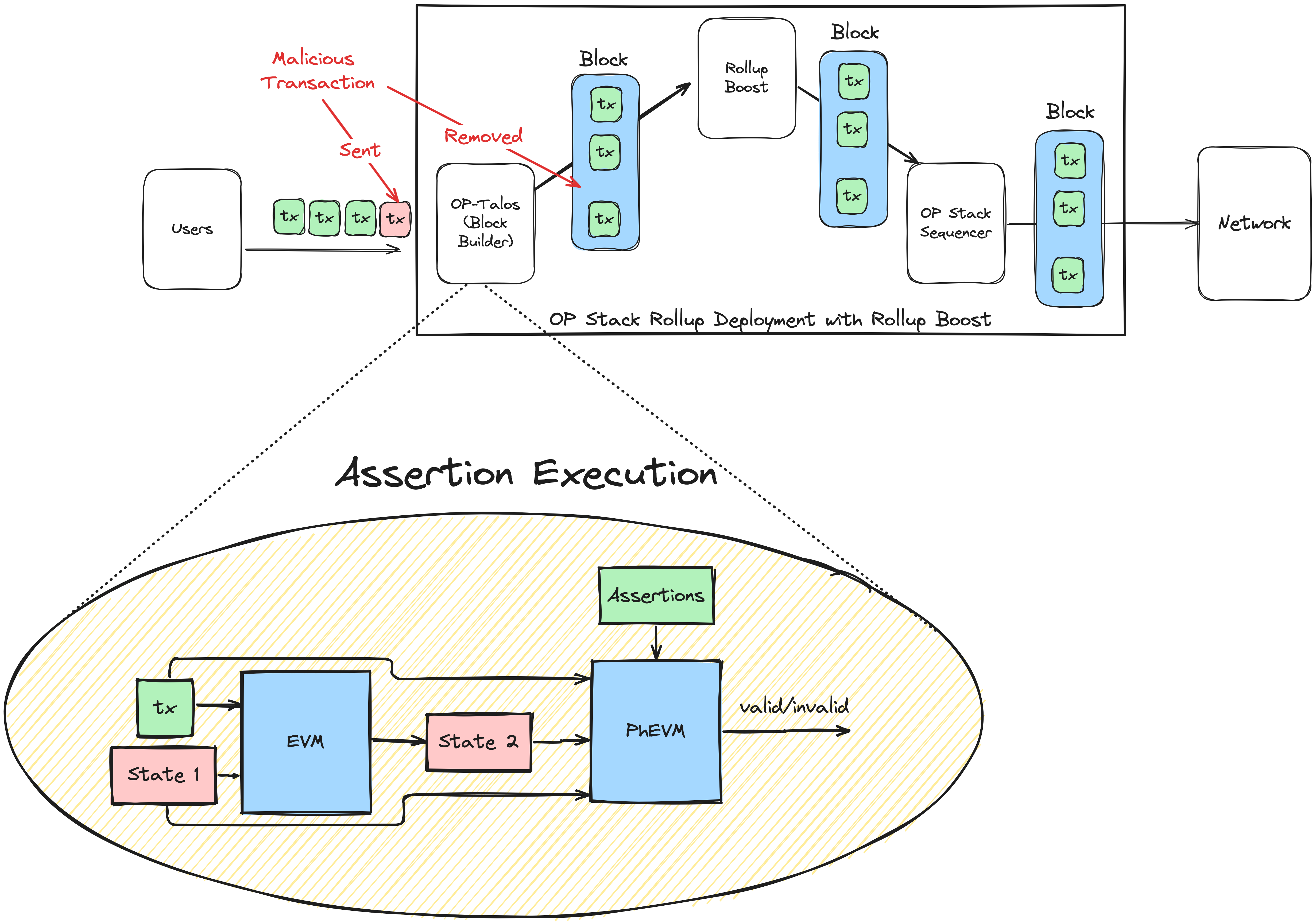 The diagram above illustrates transaction flow through the OP Stack implementation. The top section shows the complete deployment: users submit transactions that flow through OP-Talos (block builder) → Rollup-Boost → OP Stack Sequencer → Network. Malicious transactions are identified and removed before reaching the sequencer.
The bottom section zooms into **assertion execution** - this process is consistent across all Credible Layer implementations, not just OP Stack. The transaction and State 1 (pre-state) flow into the EVM for simulation, producing State 2 (post-state). PhEVM then validates these states against deployed assertions, returning valid/invalid.
## Key Technologies
* **OP-Talos**: Implementation of [rbuilder](https://github.com/flashbots/rbuilder) as the Assertion Enforcer. rbuilder is Flashbots' open-source block builder, which we've adapted to include assertion validation logic for the OP Stack.
* [**Rollup-Boost**](https://github.com/flashbots/rollup-boost): Developed by Flashbots, Rollup-Boost is a proxy architecture that enables external block builders to integrate with rollup sequencers. It integrates OP-Talos with the Sequencer without requiring code changes to the Sequencer, allowing for modular and non-invasive assertion enforcement.
## Integration Benefits
This solution provides several advantages for OP Stack networks:
1. **Non-invasive**: No modifications required to the sequencer code
2. **Modular**: Assertion validation runs as a separate, upgradable component
3. **Performant**: Parallel assertion execution doesn't impact sequencer performance
4. **Flexible**: Easy to enable/disable assertion enforcement
For more details on the general architecture and other implementations, see the [Architecture Overview](/credible/architecture-overview).
The diagram above illustrates transaction flow through the OP Stack implementation. The top section shows the complete deployment: users submit transactions that flow through OP-Talos (block builder) → Rollup-Boost → OP Stack Sequencer → Network. Malicious transactions are identified and removed before reaching the sequencer.
The bottom section zooms into **assertion execution** - this process is consistent across all Credible Layer implementations, not just OP Stack. The transaction and State 1 (pre-state) flow into the EVM for simulation, producing State 2 (post-state). PhEVM then validates these states against deployed assertions, returning valid/invalid.
## Key Technologies
* **OP-Talos**: Implementation of [rbuilder](https://github.com/flashbots/rbuilder) as the Assertion Enforcer. rbuilder is Flashbots' open-source block builder, which we've adapted to include assertion validation logic for the OP Stack.
* [**Rollup-Boost**](https://github.com/flashbots/rollup-boost): Developed by Flashbots, Rollup-Boost is a proxy architecture that enables external block builders to integrate with rollup sequencers. It integrates OP-Talos with the Sequencer without requiring code changes to the Sequencer, allowing for modular and non-invasive assertion enforcement.
## Integration Benefits
This solution provides several advantages for OP Stack networks:
1. **Non-invasive**: No modifications required to the sequencer code
2. **Modular**: Assertion validation runs as a separate, upgradable component
3. **Performant**: Parallel assertion execution doesn't impact sequencer performance
4. **Flexible**: Easy to enable/disable assertion enforcement
For more details on the general architecture and other implementations, see the [Architecture Overview](/credible/architecture-overview).